Data Entry

TYPING TEST

________________________________________________________________________________________________________________________________
LIST OF INVENTORY DATA
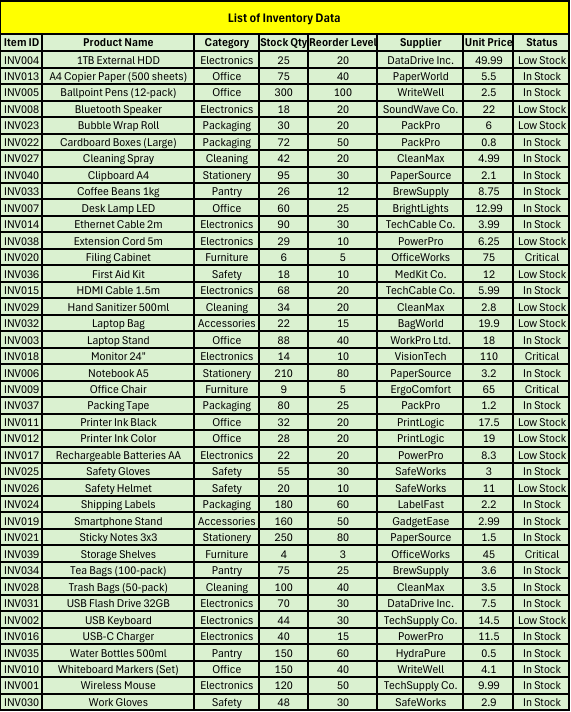
As a data entry specialist, I compiled and structured a complete inventory dataset containing multiple product categories, ensuring that all stock, supplier, and pricing information was entered accurately and systematically.
1. Setting Up Inventory Fields
- I began by establishing key data fields such as Item ID, Product Name, Category, Stock Quantity, Reorder Level, Supplier, Unit Price, and Status to create a clear framework for organizing each inventory item.
2. Entering Product and Category Details
- I recorded the name and corresponding category of every item—ranging from electronics and office supplies to cleaning and packaging materials—to maintain proper item classification and streamline sorting.
3. Inputting Stock Levels and Pricing
- I entered detailed stock information, including available quantity, reorder level, and unit price for each product, ensuring accuracy because these values are essential for monitoring inventory health and budgeting.
4. Adding Supplier Information and Stock Status
- I included the designated supplier for every item and specified its stock status (In Stock, Low Stock, or Critical) to support effective purchasing decisions and timely restocking.
5. Ensuring Data Accuracy and Consistency
- I reviewed the entire dataset to check for missing values, duplicates, or inconsistencies, ensuring each entry matched its category, supplier, and stock condition.
6. Using Spreadsheet Software for Organization
- I used spreadsheet tools to input, format, and organize the data, applying color coding, borders, and filters to enhance clarity while sorting and arranging the table to make the inventory easy to read, update, and analyze.